Updated August 2026
Choosing art for your home can feel surprisingly intimidating. Should it match the sofa? Does it need to contain the same colours as the curtains? Is the painting too big, too bright or too unusual for the room?
Here is the most important thing I can tell you as an artist: there are no art police.
Your home is personal, and the art you live with should be personal too. A few practical guidelines can help a painting sit comfortably in a room, but they should never stop you from choosing something that makes you feel happy, curious or inspired.
So, how do you choose abstract art for your home with confidence? Start with the feeling, then consider colour, scale and placement.
1. Start with the art you love
Before measuring walls or comparing paint swatches, pay attention to your first reaction.
Does the painting draw you in? Does it lift the mood of the room in your imagination? Do you keep returning to it for another look?
Abstract art does not tell you exactly what to see. One person may find a painting calm and meditative, while another sees energy, movement or a memory. That personal response is part of the joy of owning an original artwork.
Trends change. Sofas are replaced and walls are repainted. Art you genuinely love has a much better chance of staying with you through all of it.
2. Choose a mood before choosing a colour
Think about how you want the room to feel.
- For a peaceful bedroom or reading corner, you might prefer gentle movement, open space and softer tones.
- For a living room that needs energy, look for stronger contrast, expressive lines or lively colour.
- For an entrance hall or dining room, a bold statement painting can give the space character immediately.
- For an office, consider art that feels focused, optimistic or imaginative to you.
This approach is often more useful than trying to match an exact shade. Two blue paintings can create completely different moods: one may feel quiet and spacious, while the other feels dramatic and electric.
3. Let colour connect—or contrast
No, your artwork does not have to match your sofa.
It can relate to the room in several ways:
Echo a colour already in the space
A small touch of colour in the painting can repeat a cushion, rug, vase or wall colour. It does not need to be an exact match. A loose connection is often enough to make the room feel considered.
Add a contrasting accent
In a mostly neutral room, a colourful abstract painting can become the focal point. Warm reds, oranges and yellows bring energy, while blues, teals and greens can introduce freshness and depth.
Keep things calm and tonal
If the room already contains several colours or patterns, a black-and-white painting or a restrained palette can create a visual pause.
Mix warm and cool tones
A cool-toned room does not always need cool-toned art. A touch of warmth can stop a grey, blue or white space from feeling flat, just as a cooler painting can balance a room filled with warm wood and earthy colours.
The goal is not perfect matching. It is creating a relationship between the artwork and the room.

4. Get the scale right
The most common mistake is choosing art that is too small for the wall.

For a painting above a sofa, bed, sideboard or console, a helpful starting point is for the artwork—or the full arrangement of several artworks—to measure about 60% to 75% of the furniture’s width.
For example, if your sofa is 200 cm wide, look for an artwork or grouping approximately 120 to 150 cm wide.
This is a guideline rather than a strict rule. A deliberately oversized painting can look spectacular, while a small artwork can work beautifully when it is given its own intimate wall or combined with other pieces.
If one painting feels too small for the space, you could:
- Hang two or three related artworks together.
- Create a gallery wall around it.
- Place it above a smaller piece of furniture.
- Give it breathing room on a narrow wall or in a reading corner.
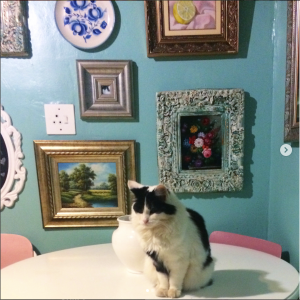
Before buying, mark the proposed size on the wall with low-tack painter’s tape or make a paper template. Step back and view it from across the room. This simple test makes scale much easier to judge.
5. Consider the shape of the wall
The orientation of a painting can help it feel at home in a particular space.
- Landscape artwork works naturally above sofas, beds and sideboards.
- Portrait artwork suits narrow walls, entrances and spaces between windows or doors.
- Square artwork is flexible and works well above a small console, in a reading corner or as part of a grouping.
- Round or unusually shaped artwork can soften a room filled with straight architectural lines and rectangular furniture.
Look at the empty wall as a shape of its own. The artwork does not need to fill every centimetre, but it should feel intentional within that shape.
6. Hang the artwork in relation to the furniture
When art hangs above furniture, centre it over the furniture rather than automatically centring it on the entire wall. This visually connects the pieces and creates a balanced arrangement.

Avoid hanging the painting so high that it appears to float away from everything below it. Above a sofa or sideboard, starting with a gap of roughly 15 to 25 cm often works well. Adjust this according to the artwork, the furniture and the height of the room.
For an artwork on an open wall, aim for the centre of the painting to sit around average eye level. Again, this is only a starting point: a home should suit the people who live in it.
7. Think about light and viewing distance
Natural light can bring out colour and texture beautifully, but avoid placing an original painting where it receives harsh direct sunlight for long periods. Strong sunlight can affect colours and materials over time.
Also consider how you will usually see the work. A large, energetic abstract painting may need distance to appreciate the full composition, while a smaller, detailed piece invites you to come closer.
If the room is dim, a picture light or an adjustable spotlight can help the artwork come alive. Choose lighting that does not generate excessive heat close to the surface.
8. Buy original art online with confidence
Photographs make discovering art online wonderfully convenient, but always check the practical details before ordering.
Look for:
- The exact dimensions in centimetres.
- The medium and surface, such as acrylic on stretched canvas.
- Clear photographs of the full artwork and close-up details.
- Information about the edges, finish, framing and hanging hardware.
- Whether a certificate of authenticity is included.
- Delivery, collection and return information.
It can also help to take a photograph of your wall and place a screenshot of the artwork over it using a simple design app. The mock-up will not be perfectly accurate, but it can help you imagine the colours, orientation and scale in your room.
If you are unsure, contact the artist or gallery. Asking for another photograph, a close-up or guidance about a particular space is completely reasonable.
Trust your own response
Good decorating creates balance, but art brings personality.
Choose a painting because you want to live with it—not only because it matches something you may replace in a few years. Pay attention to the mood you want, choose a size that feels confident on the wall, and let colour connect with the room in a natural way.
And if the artwork you love happens to match the sofa perfectly? That is allowed too.
Ready to find a painting that feels like yours? Browse Zhanna’s available original abstract art, or meet the artist behind the work. Every original artwork includes a certificate of authenticity.
Frequently asked questions
Does artwork have to match the sofa?
No. Artwork can echo one or two colours already in the room, introduce a contrasting accent or create an entirely different mood. It should feel connected to the space, but it does not need to match the furniture exactly.
What size artwork should I hang above a sofa?
A useful starting point is for the artwork, or the full grouping of artworks, to measure approximately 60% to 75% of the sofa’s width. Use painter’s tape or a paper template to test the proportions on your wall before buying.
Should artwork be centred on the wall or the furniture?
When a painting hangs above a sofa, bed or sideboard, it usually looks more balanced when centred over the furniture. On an open wall, position it in relation to the wall and the way people move through the room.
Can I mix different art styles in one room?
Yes. Different styles can work together when there is a loose connection such as colour, mood, framing or scale. A collection built around pieces you genuinely love often feels more personal than a perfectly matched set.
Zhanna Lutova is a painter, designer and art dealer based in Johannesburg, South Africa. From her West Rand studio, she creates richly textured abstract works using acrylics and mixed media, combining pouring, splattering, spinning and other experimental techniques. Drawing on decades of art and fashion design experience, Zhanna believes abstract art invites us to let go of perfectionism and discover our own meaning in every painting.